
The Underestimated Greenhouse Gas with Enormous Climate Impact
The Earth is at a turning point. While global attention focuses on CO₂ and methane, a highly potent greenhouse gas remains largely overlooked: nitrous oxide (N₂O). Its destructive impact on the climate and ozone layer is scientifically proven — yet political and societal pressure to act remains minimal. Agriculture lies at the center of this issue. The question that concerns us all: when will agriculture finally be forced to switch to regenerative, climate-friendly methods? Only through a radical transformation can we preserve the planet for future generations.
Stronger than CO₂
Scientifically known as dinitrogen monoxide (N₂O), nitrous oxide is a frequently overlooked but extremely potent greenhouse gas that plays a central role in climate change. It has a global warming potential 265 to 300 times greater than carbon dioxide (CO₂) and remains in the atmosphere for over 100 years, making it one of the biggest challenges in global climate protection today.
Physical and Chemical Properties
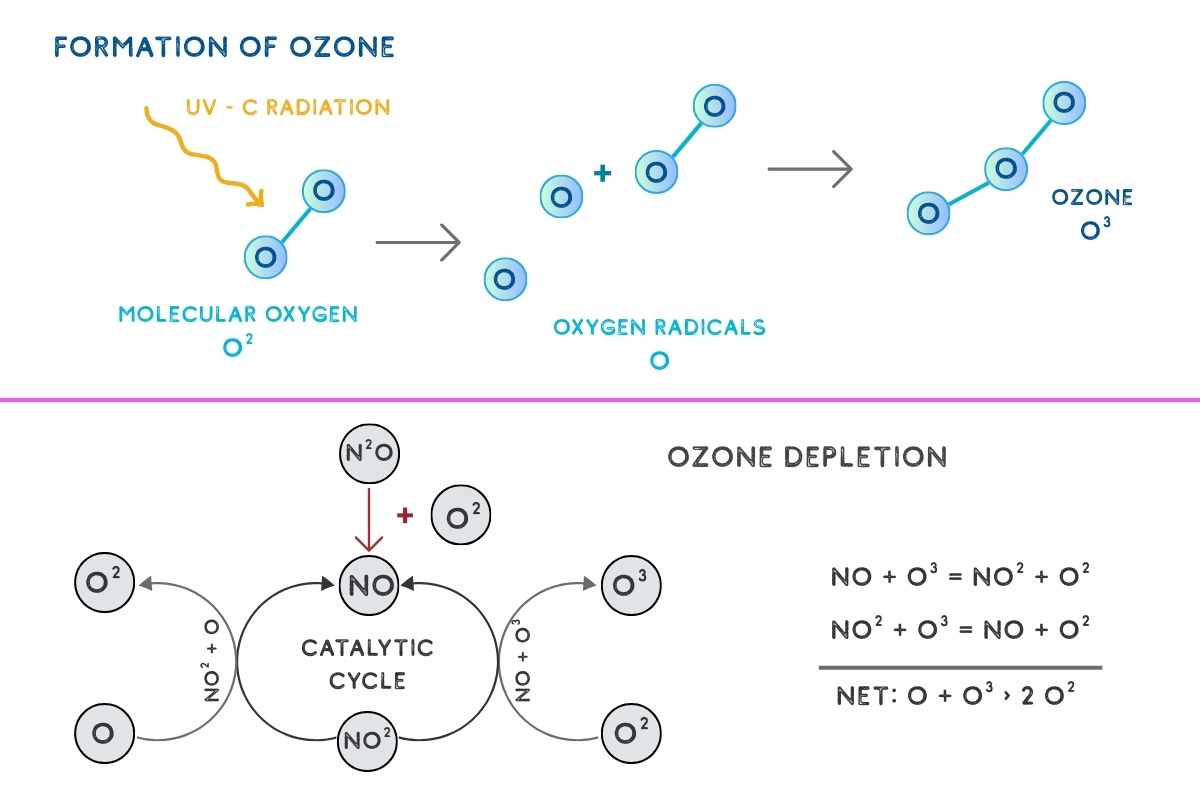
Nitrous oxide is a colorless gas with a sweet smell, and the chemical formula N₂O. It belongs to the group of nitrogen oxides and is stable at room temperature. Its significant climate impact comes from its ability to absorb and re-emit long-wave infrared radiation. N₂O stays in the atmosphere for an average of 114 to 150 years — much longer than methane (12 years), though shorter than CO₂. Its physical properties make it particularly problematic as a greenhouse gas. Not only is it 265 to 300 times more climate-damaging than CO₂, but it also contributes to the depletion of the stratospheric ozone layer. In the stratosphere, N₂O breaks down into nitric oxide (NO) and nitrogen dioxide (NO₂), which catalytically destroy ozone.
Origin and Biological Processes
Anthropogenic Nitrous Oxide Emissions by Sector (as percentages)
Nitrous oxide is primarily produced through microbial processes in soils, involving the conversion of nitrogen compounds. The main biological pathways include:
Nitrification
In nitrification, ammonium (NH₄⁺) is oxidized to nitrite (NO₂⁻) by ammonium-oxidizing bacteria (AOB), and then to nitrate (NO₃⁻) by nitrite-oxidizing bacteria (NOB). N₂O is produced as a byproduct, particularly through the oxidation of hydroxylamine or via nitrification-denitrification.
Denitrification
Denitrification is an anaerobic process in which nitrate is reduced through several steps to molecular nitrogen: NO₃⁻ → NO₂⁻ → NO → N₂O → N₂. Under unfavorable conditions such as low oxygen levels or unbalanced carbon-to-nitrogen ratios, the process may be incomplete, leading to increased N₂O emissions.
Chemical Denitrification
Recent research has shown that N₂O can also be produced chemically without microbial involvement. This chemo-denitrification occurs when divalent iron reacts with nitrite and can account for up to 25% of N₂O production in coastal sediments.
Atmospheric Development and Global Trends
Atmospheric Nitrous Oxide Concentration (N₂O) from 1750 to 2022
Since the Industrial Revolution, atmospheric concentrations of N₂O have steadily risen. While pre-industrial levels were around 270 ppb (parts per billion), they had reached 336 ppb by 2022 – an increase of 25% since 1750.
Most concerning is the acceleration of this increase in recent decades. Since 1980, anthropogenic emissions have grown by 40%. Over 10 million tons of N₂O were emitted per year in 2020 and 2021 – record highs.
There are clear regional differences: emissions have decreased in Europe due to improved technologies and more efficient fertilizer use, while emissions in rapidly developing countries like China and India have surged, driven by population growth and intensified agriculture.
Anthropogenic Emission Sources
Agriculture as the Main Driver
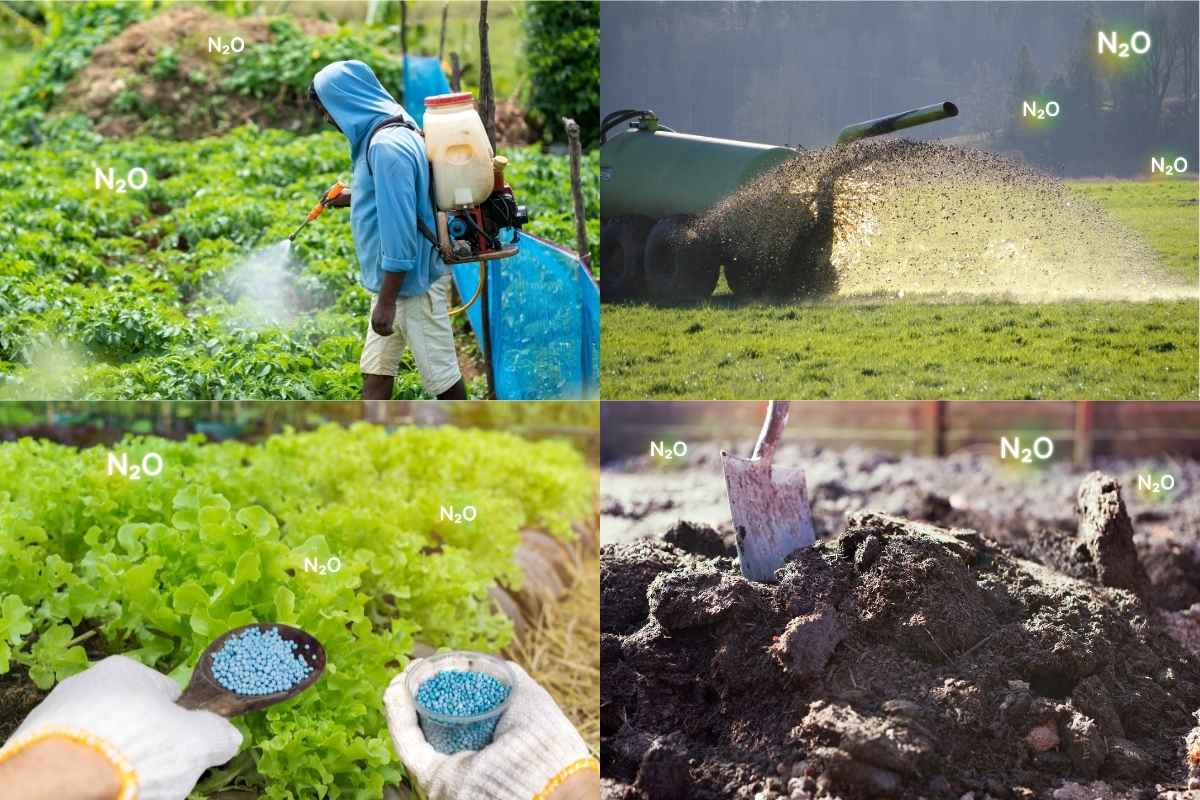
Agriculture accounts for 74-78% of anthropogenic N₂O emissions. A major problem is the use of nitrogen fertilizers, both mineral and organic.
Mineral Fertilizers
Mineral nitrogen fertilizers, produced using the Haber-Bosch process, are responsible for the bulk of agricultural N₂O emissions. When excess fertilizer isn’t absorbed by plants, microbes convert the surplus nitrogen to nitrous oxide.
Global mineral nitrogen fertilizer production rose from 60 million tons in 1980 to 107 million tons in 2020 — a 78% increase that directly correlates with rising N₂O emissions.
Organic Fertilizers and Livestock Manure
Manure and other organic fertilizers also significantly contribute. Emissions from livestock manure are even higher than those from mineral fertilizers. In 2020, manure use equaled that of mineral fertilizers, with over 200 million tons of nitrogen fertilizers applied in total.
Industrial Emissions
Industry contributes around 5-10% of global N₂O emissions. Major sources include:
Nitric Acid Production
Used mainly in fertilizer production, this process releases large amounts of N₂O.
Adipic Acid Production
Used in nylon manufacturing, this also releases significant quantities of nitrous oxide.
Energy Sector and Transport
The energy sector is responsible for 8-12% of emissions, mainly from fossil fuel combustion. Transport accounts for 3-5%, where N₂O is released during combustion in engines.
Natural Sources and Sinks
Some 57-64% of global N₂O emissions come from natural sources:
Oceanic Sources
Oceans – especially coastal waters – are a major natural source. Upwelling currents bring nutrients to the surface, where microorganisms convert them into N₂O. The GEOMAR Helmholtz Centre operates the world’s largest N₂O ocean data repository.
Terrestrial Soils
Natural soils emit N₂O through microbial nitrogen conversion, which is a regular part of the nitrogen cycle in all ecosystems.
Sinks
The primary sink for nitrous oxide is the stratosphere, where 12.2 to 13.4 million tons of N₂O-N are chemically broken down each year, a process that also contributes to ozone depletion.
Environmental Impacts
Climate Impact
Despite its low atmospheric concentration, N₂O accounts for about 6-7% of the total greenhouse effect. Its warming potential is 265 to 300 times that of CO₂, making it the third most important greenhouse gas after CO₂ and methane.
Ozone Depletion
Nitrous oxide is currently the most harmful ozone-depleting substance. Following the global phase-out of CFCs, N₂O has become the primary driver of ozone loss.
Ecosystem Effects
Excess nitrogen not only affects the air but also soils and waterways. Rivers like the Elbe show “hotspots” of high N₂O concentrations caused by agricultural nutrient runoff.
Mitigation Measures and Technologies
Agricultural Measures
Agriculture holds the greatest potential for N₂O reduction, but solutions are challenging to implement.
More Efficient Fertilization
Improved fertilizer management can significantly reduce N₂O emissions, including:
- Matching fertilizer use precisely to crop requirements
- Optimizing application timing
- Use of nitrification inhibitors
- Planting cover crops to bind nitrogen
Organic Farming
Organic farming shows lower emissions per hectare. Studies indicate that reducing fertilizer intensity by 15% can dramatically cut N₂O emissions.
Industrial Measures
Available technologies allow for cost-effective reduction of industrial N₂O emissions.
Catalysts in Nitric Acid Production – Can reduce N₂O emissions by over 90%. The Nitric Acid Climate Action Group (NACAG) promotes global adoption.
Thermal Decomposition
High temperatures convert N₂O into harmless nitrogen and oxygen, and are already used in some facilities.
Technological Innovations
New technologies for reducing nitrous oxide emissions are constantly being developed
Dynamic Regulation in Wastewater Treatment
Smart systems with sensors can minimize N₂O emissions by controlling process parameters precisely.
Ammonia Stripping
Removes ammonia from wastewater and produces ammonium sulfate fertilizer, which can be used more efficiently in agriculture.
Climate Policy Importance
Paris Agreement
The goal of limiting global warming to well below 2°C, ideally 1.5°C, requires a 43% reduction in greenhouse gases by 2030. N₂O must be included in comprehensive strategies; rising emissions pose a serious threat to meeting these goals.
National Climate Action Plans
Germany has committed to reducing greenhouse gas emissions by at least 40% by 2030 as part of EU obligations. Given that 67% of Germany’s N₂O emissions stem from agriculture, the government supports research into reducing emissions from croplands.
Regional Differences and Global Challenges
Developing Countries
Populous countries with growing agricultural intensification, such as China and India, are driving rapid N₂O increases.
Industrialized Countries
In Europe and other developed nations, N₂O emissions have partially declined due to better technology and fertilizer practices.
Global Action Required
Rising emissions in developing nations are outpacing reductions elsewhere. Without global coordination, climate targets will be missed.
Monitoring and Measurement Technologies
Atmospheric Monitoring
A global network of stations monitors atmospheric N₂O concentrations. These measurements are essential for tracking emission trends.
Emission Measurement Approaches
Quantification of N₂O is complex and uses several methods:
- Bottom-up estimates from measurements and models
- Top-down estimates based on atmospheric data
- Inverse modeling for source identification
Research Needs
Experts call for a more comprehensive global N₂O monitoring network—including data from oceanic sources, one of the largest natural emitters.
Future Challenges
Demographic Change
Population growth and changing diets are increasing demand for food and feed, putting more pressure on agriculture and N₂O emissions.
Technological Solutions
Precision agriculture, improved fertilizers, and biotech approaches could help – but must be made globally accessible.
Policy Measures
Effective climate policy must address N₂O emissions through:
- International emission reduction agreements
- Financial incentives for clean technologies
- Regulation of fertilizers and industrial processes
Economic Aspects
Cost of Emission Reductions
Industrial measures are relatively low-cost—retrofitting a nitric acid plant with catalysts can cost only a few million euros. Agricultural efforts are more complex and expensive, though efficient fertilization can create long-term economic benefits.
Market Mechanisms
Carbon markets could incentivize N₂O reductions. Its high global warming potential makes such reductions particularly valuable.
Conclusion and Outlook
Nitrous oxide is one of the greatest challenges for global climate protection. With its extremely high warming potential and long atmospheric lifetime, it significantly contributes to global warming. The continued rise in emissions—especially from agriculture—jeopardizes the goals of the Paris Agreement.
Solving the problem requires a comprehensive approach:
- Technological innovations in agriculture and industry
- International cooperation on global emission reductions
- Policy measures for regulation and incentives
- Raising awareness of this “forgotten” greenhouse gas
Crucially, effective climate protection cannot rely solely on CO₂ reductions. Other greenhouse gases like N₂O must be equally addressed. The technologies to reduce it—especially in industry—are available and cost-effective.
The real challenge lies in implementing global strategies that balance rising food production needs with climate action. Only through coordinated, international efforts can the N₂O problem be solved and a vital contribution made to protecting our planet’s climate.
Author: Francesco del Orbe 🌍



1 Comment. Leave new
Really well-written article! 👏 I enjoyed the way you broke down the topic—it feels very genuine and helpful, not just theory. The practical tips make it easy for readers like me to connect and actually take something useful away.At meinestadtkleinanzeigen.de , we’re building a directory and classifieds platform in Germany where people can discover businesses, services, and opportunities across many categories. That’s why I especially value content like yours, because it shows how sharing knowledge online can really create connections.Keep up the great work—I’ll definitely be following along for more insights! 🚀