– How Factory Ships and Seaweed Can Change the World
The Vision: Factory Ships as a Green Revolution at Sea
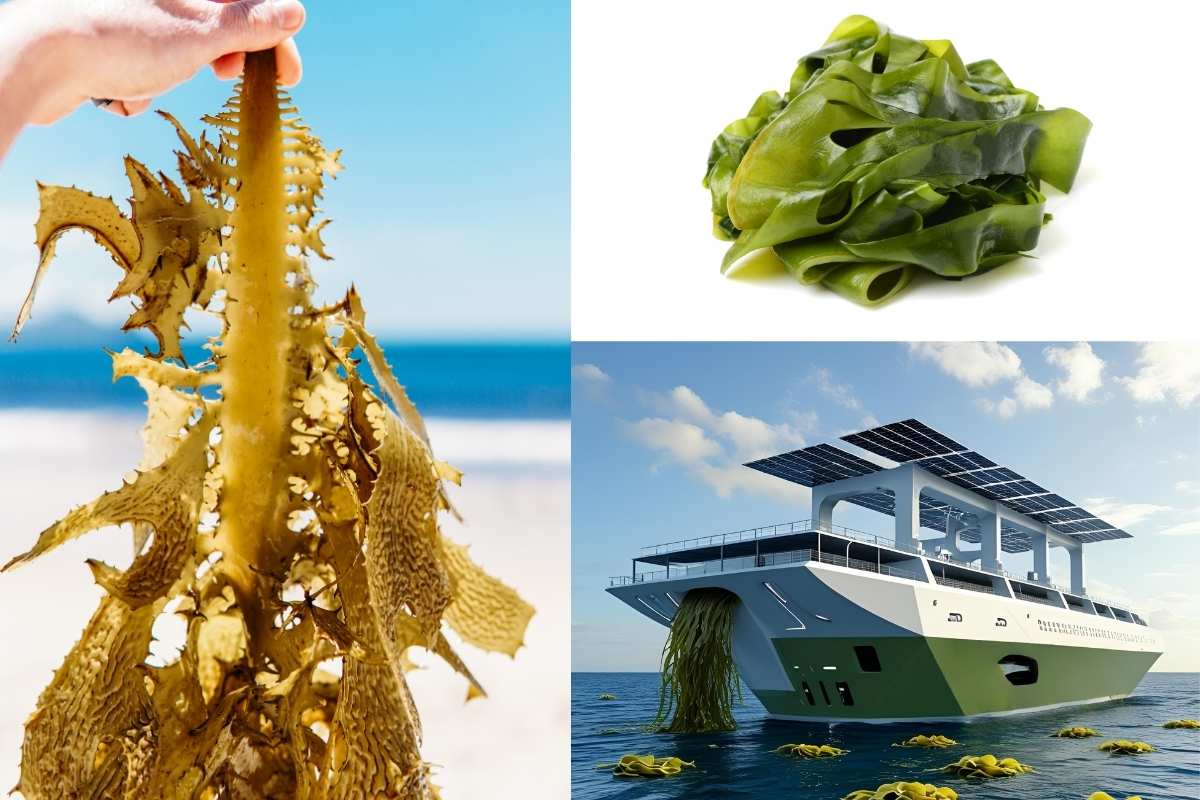
Imagine vast fields of kelp and other macroalgae growing among the waves – not just alongside offshore wind farms, but wherever it makes ecological and economic sense. Fully automated factory ships harvest these algae, process them directly on board, and transform them into sustainable packaging for fast-food chains and major events – or into biochar that permanently stores CO₂ and serves as an energy source. This is no distant utopia, but a concept that is already gaining momentum worldwide.
Why Seaweed? The Superpowers of Ocean Plants
- Extremely high CO₂ uptake: Seaweeds – especially large kelp species – absorb huge amounts of CO₂ directly from the ocean. Kelp can bind up to 3,000 tons of carbon per square kilometer – more than any tropical rainforest.
- Urgent need: Our oceans are becoming dangerously acidified as they absorb more and more CO₂. They no longer release it, but store it – with severe consequences for marine life. It is therefore urgently necessary to actively remove CO₂ from the ocean to stop acidification and restore balance.
- No competition with farmland: Seaweed requires no freshwater, no fertilizers, and no arable land.
- Regenerative impact: Seaweed farms support biodiversity and improve water quality.
The Technology: How Floating Biorefineries Work
- Offshore and Coastal Seaweed Farms:
- Mechanized harvesting: Specialized vessels such as the “SeaCombine” or “Harvest Buddy” system autonomously harvest large amounts of kelp daily – either offshore or in suitable coastal zones.
- Flexible locations: These farms are not limited to areas near wind parks, but can be deployed wherever conditions are optimal – from quiet bays to open ocean waters.
- Onboard Processing:
- On-site utilization: Once harvested, algae are immediately pressed, dried, or fermented on the ship, minimizing transport and emissions.
- Biorefinery at sea: Modern factory ships can convert algae directly into packaging materials, bioplastics, or biochar – all on board.
Seaweed Packaging: The Sustainable Alternative for McDonald’s & Co.
- Biodegradable: Seaweed-based packaging decomposes fully – even if dispersed in the environment at scale.
- Industry-ready: Companies such as Notpla, Evoware, and B’ZEOS are developing seaweed packaging that integrates into existing production lines and is already being tested by fast-food chains.
- Edible packaging: In Asia, edible ketchup sachets made from seaweed are emerging – just eat them instead of throwing them away.
| Advantage | Seaweed Packaging | Plastic Packaging |
| Biodegradable | Yes | No |
| Microplastic-free | Yes | No |
| CO₂ sequestration | Very high | None |
| Water consumption | Minimal | High |
| Compostable | Yes | No |
Algae Biochar: Carbon Sink and Energy Source
- On-board pyrolysis: Some algae biomass is turned into biochar directly onboard. This process locks in carbon and produces energy usable for the ship or packaging production.
- Circular economy: The biochar can be used as a soil enhancer on land or as “carbon bricks” in construction – remaining stable for centuries.
- Energy autonomy: Energy from pyrolysis makes these ships less dependent on fossil fuels.
Challenges and Opportunities
- Technology & scalability: Mechanized offshore harvesting and processing are challenging, but the first prototypes and specialized vessels are already operating.
- Regulations: International standards and certifications are needed to verify CO₂ storage and product quality.
- Market breakthrough: Collaboration with big brands and high-visibility events is key to making seaweed packaging mainstream.
A Message to the ‘Big 50’: Time to Step Up
I call on the world’s largest brands – McDonald’s, Burger King, Coca-Cola, Nestlé, the big coffee chains and more – to invest at least 2% of their annual revenue into these meaningful solutions to save our planet. Now is the time to stop talking about sustainability and start taking responsibility for the products you sell and their impacts.
My Promise: If you take this step, I’ll come visit – and will gladly eat and drink at your stores. Show the world you’re serious about protecting our oceans and securing the future of our planet.
Conclusion: “Let’s Keep Going – Let’s Save the Ocean!”
The combination of large-scale kelp farms in strategic locations, floating biorefineries, and sustainable products is a true game-changer for the climate, economy, and environment. This type of seaweed is a CO₂-sequestration superstar and helps relieve the ocean from carbon overload – a mission more urgent than ever in the face of advancing acidification and the climate crisis.
Now is the time to invest boldly, to research, and to scale. Let’s save the ocean – together, with innovation, passion, and the power of seaweed!
Author: Francesco del Orbe 🌍