– What They Are and Why We Are in a High-Risk Zone
The dramatic truth: Six out of nine planetary boundaries have already been crossed. Humanity has leftthe safe operating space and is now entering the dangerous high-risk zone for our Earth system.
What Are Planetary Boundaries?
The concept of planetary boundaries was developed in 2009 by an international team of 29 scientists ledby Johan Rockström. These nine critical Earth system processes regulate the stability and resilience of ourplanet. When these limits are exceeded, the risk of serious and potentially irreversible environmentalchanges increases dramatically. Planetary boundaries act like a “health check for the Earth.” Katherine Richardson from the University ofCopenhagen, lead author of the 2023 study, explains: “We can imagine the Earth as a human body and the planetary boundaries as a kind of blood pressure. Avalue over 120/80 doesn’t mean an immediate heart attack, but it increases the risk.
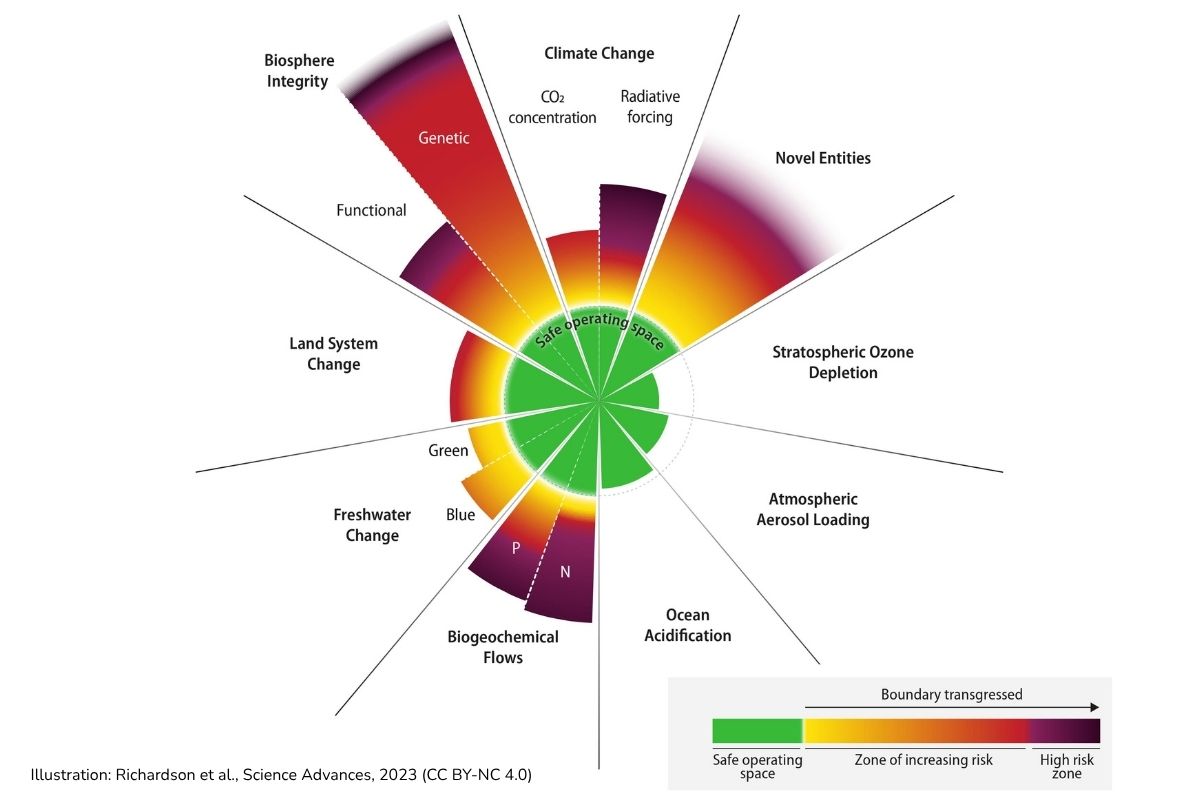 ”The length of the wedges symbolizes how far the current state of a process is from its planetary boundary (end of green zone) and from the Holocene baseline (center). The color shows the associatedrisk. A wedge may be long because the process has already veered far from the safe zone but still not bemarked as purple if it’s not yet linked to extreme risk. In other processes, even a small overshoot canpose huge risks – then the color turns purple much earlier.
The Dramatic Trend: From 3 to 6 Crossed Boundaries Scientific data show an alarming acceleration:
- 2009: 3 out of 9 boundaries crossed
- 2015: 4 out of 9 boundaries crossed
- 2023: 6 out of 9 boundaries crossed
2023, for the first time, all nine planetary boundaries could be fully quantified – and the results arealarming. The Three High-Risk Boundaries.
1. Climate Change CO₂ concentration:
- 417 ppm (safe limit: 350 ppm)
- Radiative forcing: +2.91 W/m² (safe limit: +1.0 W/m²).
2. Biosphere Integrity
- Extinction rate: Over 100 E/MSY (limit: 10 E/MSY)
- Around 1 million species out of an estimated 8 million are at risk of extinction.
3. Biogeochemical Flows
- Nitrogen use: 190 Tg/year (safe limit: 62 Tg/year)
- Phosphorus levels: exceeded both globally and regionally.
The Other Three Crossed Boundaries (Medium Risk Zone)
4. Land-Use
- ChangeOnly 60% of original forests remain (safe limit: 75%).
5. Freshwater Systems
- Both blue water (surface/groundwater) and green water (soil moisture) exceed safe levels.
6. Novel Entities
- Chemical pollution, microplastics, GMOs, and nuclear waste releases far exceed our capacity to assessimpacts.
The Three Still Safe Boundaries
- Stratospheric Ozone Depletion: Recovery thanks to the Montreal Protocol
- Ocean Acidification: Still within safe range, but nearing the limit
- Atmospheric Aerosols: Globally still within limits.
The Most Urgent Message: Get CO₂ Under Control
The most urgent task is to stop rising CO₂ levels and cool the planet. Climate change is one of the mostcritical boundaries and acts as a multiplier for all others – it can trigger environmental cascades thatbecome irreversible. Become Climate Positive – Make a Green Earthprint. To be climate positive means doing more than being climate neutral. It means actively removing more CO₂ from the atmosphere than you produce. A green Earthprint is your positive planetary footprint – you don’t just avoid harm, you help restore the Earth.
Practical steps toward your Green Earthprint:
- Switch entirely to renewable energy
- Use energy-efficient technologies
- Promote sustainable mobility
- Support reforestation projects
- Establish a circular economy
Become a Guardian of the Earth
Being a guardian of the Earth means taking responsibility for our planet. This idea comes from indigenoustraditions, which have long seen themselves as protectors of the Earth.The ozone layer recovery success story shows: global cooperation can bring planetary boundaries backinto the safe zone. Thanks to the 1987 Montreal Protocol, the ozone layer continues to heal – provingthat restoration is possible. Since 2024, the Potsdam Institute for Climate Impact Research produces an annual Planetary HealthCheck, making Earth’s status more accessible and up to date.
Conclusion: Action Is Needed NOW
Johan Rockström, director of the Potsdam Institute, warns:“We don’t know how long we can exceed critical thresholds before irreversible damage occurs.”The message is clear: 6 out of 9 planetary boundaries are exceeded, 3 of them already in the high-riskzone. The Earth’s resilience is fading – but it’s not too late. Shift now – become climate positive – make a green Earthprint – be a Guardian of Earth! The time for half-measures is over. The time for decisive action is NOW.
Author: Francesco del Orbe 🌍