– How much time do we have left?
According to the latest scientific findings from 2025, humanity now faces an even more critical time window than predicted in 2020. The remaining CO₂ budget for the 1.5°C target is only about 130 billion tons of CO₂ and, at current emission rates, could be exhausted in roughly three years.
The dramatic worsening since 2020
While the original 2020 blog post already warned about time running out, the situation has drastically deteriorated. 2024 was the first year when the global average temperature continuously exceeded the 1.5°C threshold.Human-induced warming is now at 1.36°C above pre-industrial levels.
Global CO₂ emissions reached a new record in 2024 with 37.8 billion tons – an increase of 0.8 percent compared to 2023. Particularly alarming: atmospheric CO₂ concentrations rose to 422.5–424 ppm, a value 50 percent higher than in pre-industrial times.
The shrinking CO₂ budget: Even more dramatic than in 2020
The latest calculations by the “Indicators of Global Climate Change” are even more alarming than the 2020 forecasts:
-
130 to 250 billion tons of CO₂ remain for the 1.5°C target (50% likelihood)
-
Only 30 billion tons for an 83% probability
-
At current emission rates of about 40 billion tons per year: The budget is used up in 3 years
For higher warming targets, we have about 9 years for 1.6 – 1.7°C and 20–30 years for the 2°C target.
The collapse of natural carbon sinks
A particularly troubling trend since 2020 is the dramatic failure of natural carbon sinks. In 2023, forests, soils, and other land ecosystems absorbed only 0.44 billion tons of carbon per year – the lowest value since 2003 and far below the 2010 – 2022 average of 2.04 billion tons.
Reasons for this collapse:
-
Extreme drought in the Amazon (loss of 0.31 GtC)
- Record wildfires in Canada (0.58 GtC emissions, six times the decade average)
- Record global temperatures leading to an additional 1.73 GtC losses
Without these natural “buffers,” twice as much CO₂ would be in the atmosphere.
The role of companies: State-owned vs. private emitters
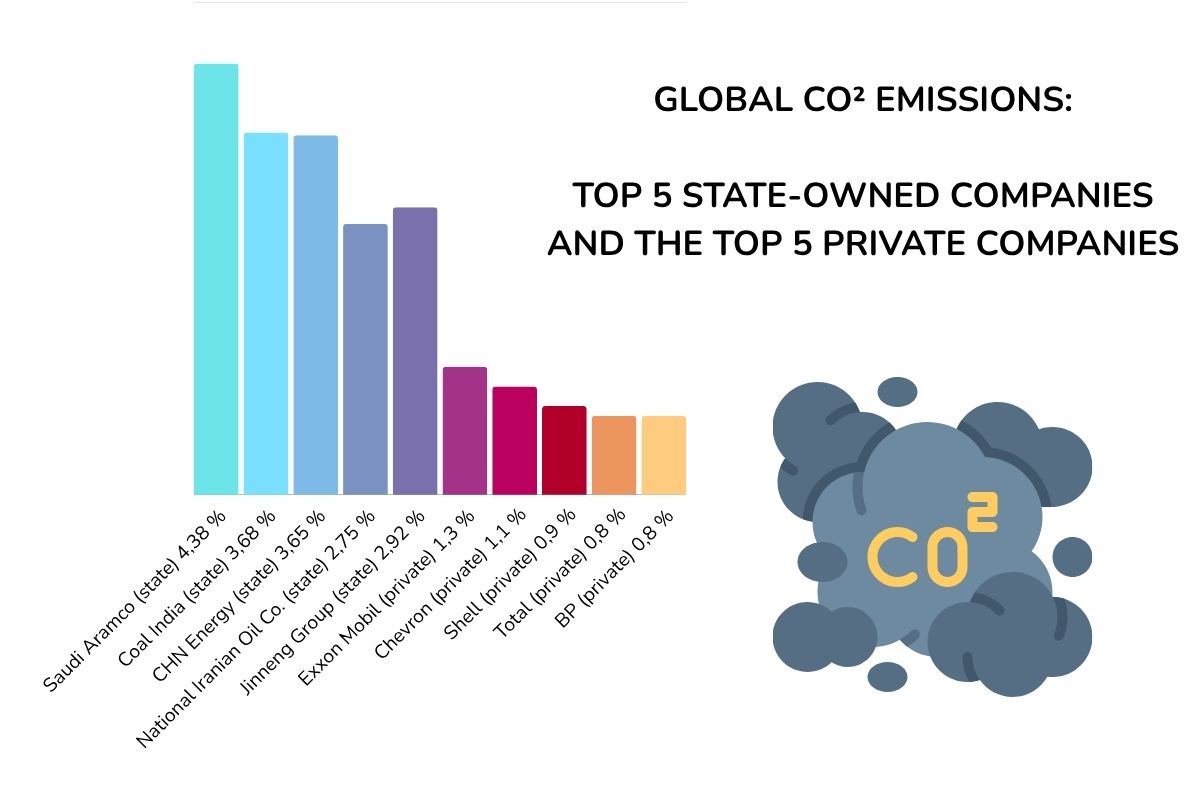
New analyses provide a clear picture of responsibility: In 2023, state-owned companies were responsible for 52 percent of global CO₂ emissions, while the five largest private companies (ExxonMobil, Chevron, Shell, TotalEnergies, and BP) caused only 4.9 percent.
The Top 5 state-owned emitters:
- Saudi Aramco: 4.38% of global CO₂ emissions
- Coal India: 3.68%
- CHN Energy: 3.65%
- National Iranian Oil Co.: 2.75%
- Jinneng Group: 2.92%
Only 36 companies were responsible for more than half of all fossil CO₂ emissions in 2023.
Tipping points: Closer to the brink
Research on climate tipping points has changed dramatically since 2020. At the current warming level, we are already in the uncertainty range for 5 tipping points. Under current policies, there is a 62 percent probability that at least one tipping point will be triggered.
The most dangerous tipping points include:
-
Collapse of the Greenland and West Antarctic ice sheets
- Breakdown of the Atlantic Meridional Overturning Circulation (AMOC)
- Amazon forest dieback
- Thawing of permafrost
Positive tipping points: A ray of hope
Despite the bleak outlook, there are also positive developments. Renewable energy has reached a positive tipping point: Solar and wind are now the cheapest sources of electricity in most parts of the world.
About 14 percent of global primary energy now comes from renewables, with an exponential growth rate. The share of electric vehicles rose from 4 percent (2020) to 14 percent (2022) of all new cars.
Costa Rica: A model for a positive Earthprint
Costa Rica demonstrates what a positive Earthprint looks like. The country generates 98–99 percent of its electricity from renewables and in 2017 set a record: 300 consecutive days with 100 percent renewable energy
With over 52 percent forest cover (target: 60 percent by 2050) and the goal of climate neutrality by 2050, Costa Rica shows that a positive Earthprint – binding more CO₂ than is emitted – is possible.
Negative emission technologies: The reality
Negative emission technologies (NETs) like Direct Air Capture (DAC) or BECCS (bioenergy with carbon capture and storage) are often pitched as an emergency plan. But the raw numbers are telling:
According to IPCC estimates, about 10 billion tons of CO₂ would have to be removed from the atmosphere annually by 2050 to reach the 1.5°C target with technical help.
In reality, all existing DAC facilities worldwide can currently remove only about 0.01 million tons of CO₂ per year—that’s just 0.0001 percent of the needed annual amount.
Even with annual doubling rates, it would take decades for NETs to play any relevant role—if they ever can at the necessary scale affordably and ecologically.
The crucial message:
The only realistic, quickly effective, and affordable option is natural carbon sinks. NATURE is the key:
- Massive reforestation
-
Protection and expansion of peatlands and wetlands
- Regeneration of soils
- Intact oceans as carbon reservoirs
Technology cannot compensate for the loss of nature. Hoping for technical solutions wastes valuable time.
The Call: Become a Guardian of the Earth
The scientific findings are clearer than ever: We have only about three years left for the 1.5°C target. But instead of resigning, we must act.
Francesco del Orbe’s message to humanity:
“If you really want to be sure something gets done, then just do it yourself!”
The path to a positive Earthprint:
- Become climate-positive: Bind more CO₂ than you cause
- Rapid CO₂ binding through reforestation, restoration, and protecting nature
- Actively cool the planet—not just offset emissions but actively strengthen nature
You are not solely to blame – 52 percent of emissions come from state-owned companies, and just 36 companies cause more than half of all fossil emissions. But you can be part of the solution.
Conclusion: The decisive years are now
Professor Fischedick’s warning from 2020 – “We’re almost at midnight” – was prophetic. In 2025, we are at the absolute point of no return for the 1.5°C target.
But Costa Rica shows: A positive Earthprint is possible. Positive tipping points in renewables and electric mobility prove: Exponential change is already happening.
The time for waiting is over. Now it’s about becoming a guardian of the Earth and leaving a positive Earthprint. Because: “We are the world!” – and only together can we save our planet.
Every tenth of a degree less warming, every ton of CO₂ bound, every positive Earthprint counts. Transformation is possible – it must simply start now.
We are the world! It’s now up to us – to help nature save us and our home, because we can’t do it alone anymore.
Author: Francesco del Orbe